
For many South African businesses, VAT registration marks an important stage of growth. As turnover increases, owners often find themselves asking whether registration is compulsory, whether voluntary registration makes sense, and what happens if they wait too long.
Getting the timing right is important. Registering too late can expose your business to penalties and unexpected tax liabilities, while registering too early without understanding the implications may increase your administrative burden unnecessarily.
Understanding the rules surrounding VAT registration helps ensure your business remains compliant while making the most of the benefits available.
What is VAT?
Value-Added Tax (VAT) is a consumption tax charged on most goods and services supplied in South Africa.
VAT-registered businesses collect VAT from customers on behalf of SARS and may also recover VAT paid on qualifying business expenses through input tax claims.
Although VAT can seem complicated initially, it forms an essential part of running many successful businesses.
When is VAT Registration Compulsory?
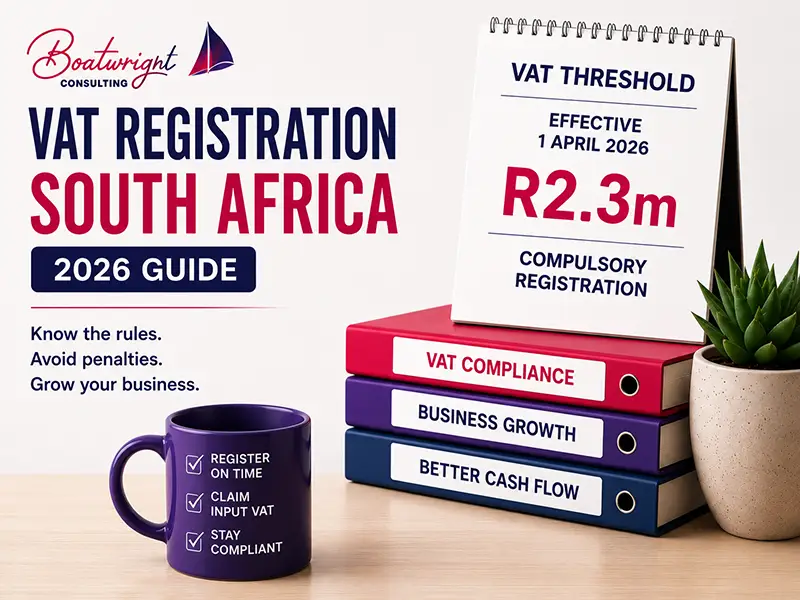
Effective from 1 April 2026, businesses are required to register for VAT once their taxable turnover exceeds R2.3 million during any consecutive 12-month period.
This threshold applies regardless of the business structure and includes:
- Sole proprietors
- Partnerships
- Close corporations
- Companies
- Trusts carrying on taxable activities
Importantly, businesses should monitor turnover continuously rather than waiting until year-end.
Once the compulsory threshold has been exceeded, registration should be submitted promptly to avoid unnecessary complications.
Why Timing Matters
Many business owners only discover they should have registered months after exceeding the threshold.
Unfortunately, SARS may backdate the registration date.
This means the business could become liable for VAT on sales already made—even where VAT was never charged to customers.
The result can be a significant financial burden that directly affects cash flow.
Can You Register Voluntarily?
Yes.
Businesses with taxable supplies exceeding R120,000 per year may choose to register voluntarily.
Voluntary registration is often beneficial where businesses:
- Supply goods or services to VAT-registered customers
- Purchase significant amounts of equipment or stock
- Incur substantial VAT on operating expenses
- Expect rapid future growth
For many growing businesses, voluntary registration provides strategic advantages long before compulsory registration becomes necessary.
Advantages of VAT Registration
Many people associate VAT only with additional administration.
However, registration also provides several important business benefits.
Claim Input VAT
One of the biggest advantages is the ability to recover VAT paid on qualifying business expenses.
Examples include:
- Office equipment
- Computers
- Professional services
- Rent (where applicable)
- Fuel in qualifying circumstances
- Stock purchases
- Manufacturing inputs
Recovering input VAT can significantly reduce operating costs.
Improve Business Credibility
Large corporate clients often prefer working with VAT-registered suppliers.
Being registered demonstrates that your business has reached a certain level of turnover and financial maturity.
For many organisations, dealing with VAT vendors also simplifies their own accounting processes.
Better Position Your Business for Growth
Businesses planning expansion often benefit from registering before they are legally required to do so.
Early registration allows systems, invoicing processes and bookkeeping procedures to become established before turnover increases further.
Risks of Registering Too Late
Delaying VAT registration can become extremely expensive.
Possible consequences include:
SARS Penalties
Failure to register when legally required may result in administrative penalties.
Backdated VAT
SARS may require VAT to be paid from the date registration should originally have taken place.
This liability exists even if customers were never charged VAT.
Interest Charges
Outstanding VAT liabilities may attract interest until settled.
Cash Flow Pressure
Unexpected VAT assessments can place enormous strain on growing businesses.
Instead of investing in expansion, businesses may suddenly need to fund historical VAT obligations.
Good Record-Keeping is Essential
VAT compliance depends heavily on accurate financial records.
Businesses should maintain:
- Tax invoices
- Supplier invoices
- Bank statements
- Accounting records
- Asset registers
- Import documentation where applicable
Strong record-keeping makes VAT submissions quicker and reduces the likelihood of SARS queries.
How Often Are VAT Returns Submitted?
Depending on your registration category, VAT returns are generally submitted every one or two months.
Returns must accurately reflect:
- Output VAT collected
- Input VAT claimed
- Adjustments where applicable
Submitting accurate returns on time helps maintain good compliance standing with SARS.
Common VAT Mistakes
Some of the most common issues include:
- Registering too late
- Claiming VAT without valid tax invoices
- Charging VAT before registration
- Incorrect VAT calculations
- Missing submission deadlines
Most of these issues can be avoided with proper accounting systems and professional oversight.
How Boatwright Consulting Can Help
VAT legislation continues to evolve, making it increasingly important for businesses to receive professional advice.
Boatwright Consulting assists clients by:
- Determining whether registration is compulsory
- Advising on voluntary registration
- Preparing VAT registration applications
- Setting up compliant accounting systems
- Preparing and submitting VAT returns
- Assisting with SARS queries and audits
Our goal is to ensure your business remains compliant while making the most of the opportunities VAT registration provides.
Final Thoughts
VAT registration represents far more than simply complying with legislation.
Handled correctly, it strengthens credibility, improves cash flow through input tax recovery and supports long-term business growth.
Whether you’re approaching the compulsory threshold or considering voluntary registration, obtaining professional advice early can help avoid costly mistakes and position your business for future success.
Need Help With VAT Registration?
If you’re unsure whether your business should register for VAT, Boatwright Consulting is here to help.
Our experienced team can assess your circumstances, guide you through the registration process and ensure your VAT obligations are handled accurately and efficiently.