
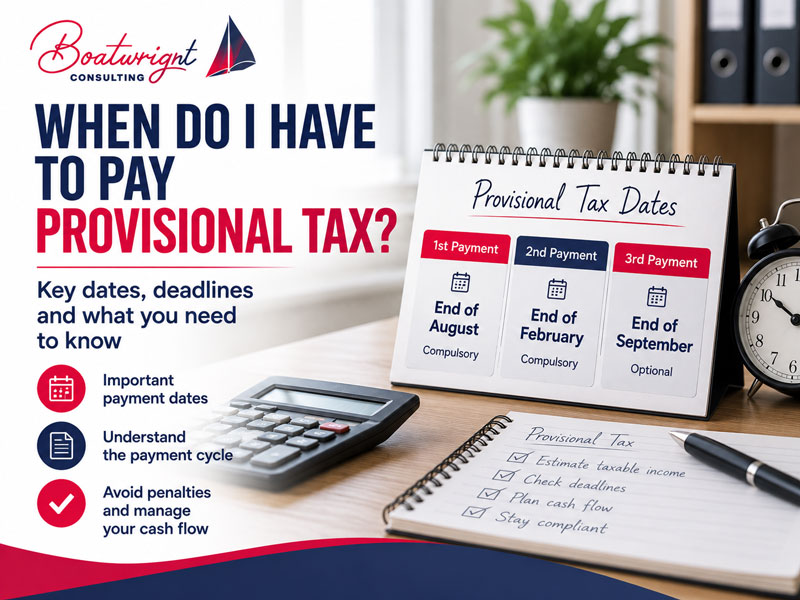
If you are a provisional taxpayer, knowing when to pay provisional tax is just as important as knowing how much to pay.
Unlike PAYE, which is normally deducted from an employee’s salary every month, provisional tax is generally paid at specific points during the tax year.
For most individuals and businesses with a February tax year-end, there are two compulsory provisional tax periods and an optional third payment.
Understanding these deadlines can help you manage your cash flow and avoid unnecessary SARS penalties and interest.
The Provisional Tax Payment Cycle
For taxpayers whose year of assessment runs from 1 March to the end of February, the provisional tax cycle generally looks like this:
| Payment | When? | Status |
| First provisional payment | End of August | Compulsory |
| Second provisional payment | End of February | Compulsory |
| Third/top-up payment | End of September following the tax year | Optional |
The exact deadline should always be checked for the applicable year because weekends and public holidays can affect the payment date.
If a payment deadline falls on a Saturday, Sunday or public holiday, SARS requires payment by the last business day before the deadline.
First Provisional Tax Payment – August
The first provisional tax payment is due within six months of the beginning of the year of assessment.
For individuals and businesses operating on the standard February tax year-end, this means the first provisional period ends on 31 August.
At this point, you need to estimate your taxable income for the entire tax year, not simply calculate the income you earned during the first six months.
This distinction is important.
Imagine a consultant has earned R350,000 between March and August.
That does not mean the provisional tax calculation is necessarily based on taxable income of R350,000.
Instead, the taxpayer needs to estimate what their total taxable income for the full tax year is likely to be.
If they expect to earn approximately R700,000 for the year, the provisional tax calculation needs to take that expected annual taxable income into account.
Second Provisional Tax Payment – February
The second provisional tax payment is due no later than the final day of the year of assessment.
For taxpayers with a February year-end, this is the end of February.
By this stage, you should have a much clearer picture of what actually happened during the year.
Your original estimate may have changed significantly.
Perhaps:
- Your business performed better than expected
- Your income decreased
- You gained or lost a major client
- You received unexpected freelance income
- Rental income changed
- Business expenses were higher or lower than anticipated
- You sold an investment and realised a taxable capital gain
- Your business experienced a particularly strong or weak second half
Your second provisional tax calculation therefore provides an important opportunity to update the estimate of your taxable income.
This is one of the reasons accurate and up-to-date bookkeeping is so important.
The Second Payment Is Particularly Important
The second provisional tax calculation deserves careful attention because SARS has rules relating to the underestimation of taxable income.
Simply choosing a conveniently low estimate to reduce your February payment can create problems later.
Your estimate should be based on reasonable financial information available at the time.
For a business owner, that could include:
- Year-to-date turnover
- Accounting records
- Business expenses
- Payroll costs
- Expected invoices
- Debtors and creditors
- Investment income
- Rental income
- Capital gains
- Other taxable income
The closer you get to the end of February, the more complete this information should become.
We cover this subject in more detail in our article “How to Accurately Estimate Your Taxable Income (And Avoid Underestimation Penalties)”.
What Is the Third Provisional Tax Payment?
There is also a third provisional tax payment, sometimes referred to as an additional or top-up payment.
Unlike the first two provisional payments, this payment is voluntary.
For individuals and companies with a February year-end, the top-up payment can generally be made by the end of September following the tax year.
Why would you voluntarily pay SARS more tax?
Because you may discover after February that your first and second payments were not sufficient to cover your actual income tax liability.
Making an appropriate top-up payment can help reduce or prevent interest arising from an underpayment.
This can happen when final accounts reveal that taxable income was higher than originally estimated.
We will deal specifically with this option in “The Third (Optional) Provisional Payment: When and Why You Should Use It.”
Do I Still Submit an IRP6 If There Is No Tax to Pay?
Potentially, yes.
A common misconception is that if your calculation results in no provisional tax being payable, you can simply ignore the provisional tax return.
SARS states that provisional taxpayers are required to request and submit the IRP6 for the first and second provisional periods even where the calculated amount payable is nil.
The return and the payment are therefore related, but they are not the same obligation.
What If My Business Has a Different Financial Year-End?
Not every company has a February year-end.
For taxpayers with another approved year-end, the provisional tax dates are calculated according to their own year of assessment.
Broadly:
First payment: Within six months from the beginning of the year of assessment.
Second payment: By the last day of the year of assessment.
The timing of an additional third payment can also differ.
For example, a company with a May year-end will not simply follow the standard August/February timetable.
This is why companies should work according to their own financial year rather than assuming that the dates applicable to individual taxpayers automatically apply to them.
Submission and Payment Are Both Important
Submitting your IRP6 does not necessarily mean that the payment has reached SARS.
You need to ensure that both the return and the required payment are dealt with by the applicable deadline.
SARS accepts provisional tax payments through approved payment channels, including eFiling and electronic banking.
If paying electronically, do not leave payment until the last possible moment without considering bank processing and cut-off times.
SARS specifically warns taxpayers to allow for bank cut-off times and possible clearance periods.
What Happens If I Miss a Provisional Tax Deadline?
Missing a provisional tax deadline can become expensive.
SARS may impose a late-payment penalty on first or second provisional tax amounts that are paid late. Interest and other consequences may also become relevant depending on the circumstances.
If you realise that a deadline has already passed, ignoring the problem generally does not improve the situation.
Determine what should have been submitted and paid, correct the position as soon as possible, and obtain professional assistance if you are uncertain about the calculation.
We cover this separately in “How to Handle Late Provisional Tax Submissions and Payments.”
Provisional Tax Requires Planning
One of the practical challenges with provisional tax is that the deadlines can arrive when a business has other demands on its cash flow.
A profitable business may have money tied up in stock, equipment or unpaid customer invoices while still having a tax liability approaching.
For this reason, provisional tax should form part of your cash-flow planning throughout the year, rather than becoming something you only think about in August and February.
Regular bookkeeping also makes it considerably easier to produce a realistic estimate when the provisional tax deadline arrives.
Need Help With Your Provisional Tax?
Provisional tax calculations can become complicated when your income changes during the year or comes from several different sources.
Boatwright Consulting can assist with assessing your provisional tax position, estimating taxable income, preparing your IRP6 submissions and determining the appropriate provisional tax payments.
Contact Boatwright Consulting if you need assistance preparing for your next provisional tax deadline or are concerned that a previous payment may have been incorrect or missed.
This article provides general information and should not be regarded as tax advice specific to your individual circumstances.