
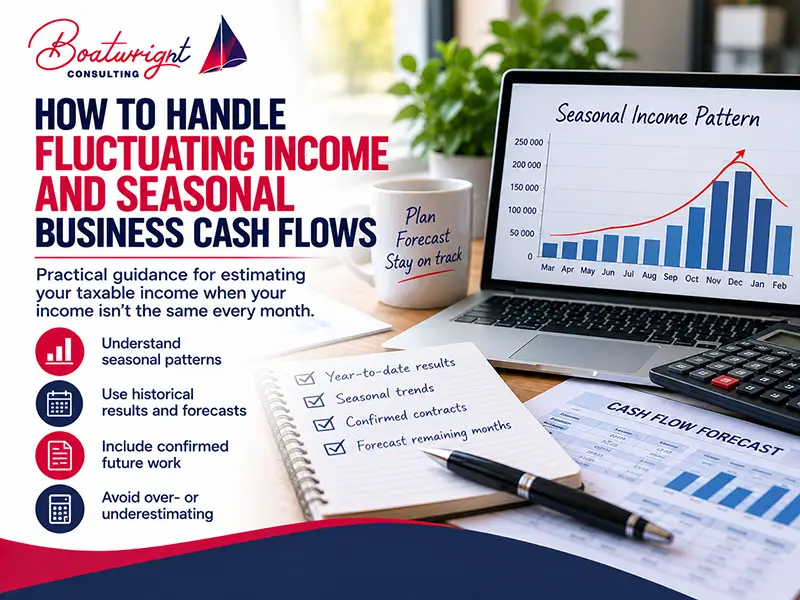
Provisional tax is relatively straightforward when a business earns roughly the same amount every month.
But many businesses don’t operate like that.
Your income might fluctuate because of seasonality, project cycles, commission payments, large once-off contracts or customers who take months to settle their accounts.
This creates a challenge when SARS asks you to estimate your taxable income for the full year.
How do you calculate provisional tax when you don’t know exactly what the next six months will look like?
The answer is not to guess blindly.
A better approach is to combine your year-to-date results with realistic forecasting, historical trends and information about what is likely to happen during the remainder of the year.
Not Every Business Earns Income Evenly
Imagine a business generating annual turnover of R2.4 million.
It would be tempting to assume:
R2.4 million ÷ 12 = R200,000 per month
But the actual income could look completely different.
A retailer might generate a large proportion of annual revenue during November and December.
A tourism business might have a strong summer season and a quiet winter.
A consultant might invoice R500,000 for one large project and very little for several months afterwards.
A commission earner might receive substantial payments only when transactions conclude.
Annual income cannot always be forecast accurately by simply multiplying one month’s income by twelve.
Why This Matters for Provisional Tax
Your first provisional tax calculation generally occurs approximately halfway through the tax year.
At that stage, you need to estimate your taxable income for the entire year.
If your business is seasonal, simply doubling the first six months can produce a misleading result.
For example:
March to August taxable profit: R250,000
A simple annualisation would produce:
Estimated annual taxable income: R500,000
But suppose 70% of the business’s profit is normally generated between September and February.
The R500,000 estimate could be far too low.
The opposite can also happen.
If the first six months contain your busiest trading period, doubling the result could substantially overestimate annual income.
Start With Historical Patterns
If your business has been operating for several years, previous results can provide useful information.
Look at:
- Monthly turnover
- Monthly gross profit
- Monthly expenses
- Seasonal peaks
- Quiet periods
- Customer-order patterns
- Previous year-end results
Don’t only compare annual totals.
Monthly information can reveal patterns that disappear when looking at a single annual figure.
For example, you might discover that the business consistently generates 40% of its annual turnover between November and January.
That is valuable information when preparing an August provisional tax estimate.
But Don’t Assume This Year Will Be Identical
Historical information is useful, but businesses change.
Ask what is different this year.
Perhaps:
- You gained a major customer
- You lost an important contract
- Prices increased
- You hired additional staff
- You opened another branch
- A product line was discontinued
- A competitor entered the market
- Demand has slowed
- A large contract has already been signed
- The business experienced an unusual once-off event
Your forecast should combine historical patterns with current information.
Use Confirmed Future Work
If you already know that income is coming, include it in your forecast where appropriate.
For example, suppose a consultant has:
Profit to August: R300,000
They also have signed contracts expected to generate substantial additional income before February.
Ignoring those contracts and simply doubling the first six months may produce an unrealistic estimate.
Likewise, if a major contract has ended and there is no replacement work in the pipeline, blindly using the previous year’s results may overstate the likely outcome.
Build a Simple Monthly Forecast
You don’t necessarily need a complicated financial model.
A basic monthly forecast can be extremely useful.
For each remaining month, estimate:
Expected income
Less:
Expected business expenses
This gives you an approximate expected monthly result.
You can then combine:
Actual year-to-date results
with:
Forecast results for the remaining months
to produce an estimated full-year position.
Example of a Seasonal Forecast
Suppose a business has produced R350,000 of profit between March and August.
Instead of simply doubling this to R700,000, management forecasts:
| Month | Expected profit |
| September | R50,000 |
| October | R70,000 |
| November | R120,000 |
| December | R160,000 |
| January | R80,000 |
| February | R70,000 |
Expected remaining profit:
R550,000
Combined with the actual first six months:
R350,000 + R550,000 = R900,000
The forecast indicates a very different annual result from the simple R700,000 estimate.
Further tax adjustments would still be required before arriving at taxable income, but the forecast is already considerably more realistic.
Cash Received Is Not Necessarily the Same as Profit
Another complication is the timing of cash.
Suppose you issue a large invoice in February, but your customer only pays in April.
Or perhaps you receive a large deposit before completing the work.
The accounting and tax treatment does not necessarily depend solely on the date money appears in your bank account.
Your accountant may need to consider when income has accrued, the nature of the transaction and the accounting/tax treatment that applies.
This is why forecasting only your bank balance can produce a misleading provisional tax estimate.
Profit Does Not Equal Cash in the Bank
A business can be profitable and still experience cash-flow pressure.
Suppose your accounts show a healthy profit, but:
- Customers haven’t paid
- You purchased stock
- You bought equipment
- You repaid debt
- You paid deposits to suppliers
- Cash is tied up in working capital
The business may therefore have limited cash available even though taxable income is substantial.
This distinction is extremely important:
Provisional tax is based on taxable income—not on how comfortable your bank balance feels.
Commission Earners Face a Similar Problem
Commission income can fluctuate significantly.
You might earn:
April: R20,000
May: R80,000
June: R15,000
July: R150,000
August: R25,000
Simply calculating an average from a few months may not reflect what is likely to happen over the full year.
Instead, consider:
- Transactions already in progress
- Historical closing rates
- Seasonal patterns
- Expected commission dates
- Contracts already signed
- Industry conditions
- Known cancellations
The estimate should reflect the information reasonably available to you.
Project-Based Businesses Need to Look at Their Pipeline
Consultants, builders, designers, agencies and professional-service businesses often work on large projects.
Their income may therefore arrive irregularly.
When estimating the remainder of the year, consider projects that are:
Confirmed
Work has been signed and is expected to proceed.
Highly probable
Negotiations are advanced but not yet final.
Possible
The opportunity exists but remains uncertain.
You should not necessarily treat every sales enquiry as guaranteed future income.
But ignoring signed contracts simply because the invoices haven’t been issued yet can also produce an unrealistic forecast.
Forecast Expenses as Well as Income
Seasonality affects expenses too.
A retailer preparing for Christmas might purchase additional stock.
A manufacturer may incur maintenance during a shutdown.
A tourism business may employ seasonal staff.
A professional firm may pay annual insurance or software subscriptions during particular months.
Your forecast should therefore consider both sides of the equation.
Do not forecast revenue carefully and then assume expenses remain identical every month.
Set Money Aside During Strong Months
One of the best ways to manage provisional tax in a seasonal business is to reserve tax during profitable periods.
Imagine your business has an exceptionally strong December.
It can be tempting to treat all the cash generated as available for:
- Stock
- Equipment
- Bonuses
- Drawings
- Debt repayments
- Expansion
But part of that profit may ultimately belong to SARS.
Setting aside an estimated tax portion while cash is available can make the February provisional payment considerably easier to manage.
Consider a Separate Tax Reserve
Some businesses find it useful to maintain a separate bank account or internal cash reserve for tax obligations.
During profitable months, money can be allocated towards expected:
- VAT
- PAYE
- Provisional tax
- Annual income tax
This does not change the amount of tax owed.
It simply helps prevent tax money from being absorbed into normal operating expenditure.
The appropriate amount to reserve depends on your circumstances and should be based on an actual tax forecast rather than an arbitrary percentage.
Review the Forecast Regularly
A provisional tax forecast should not be created in August and forgotten.
Update it as circumstances change.
For example:
August forecast: R800,000 taxable income
Then in October, the business wins a large contract.
Updated forecast:
R1,050,000
Or perhaps a major customer closes and expected revenue disappears.
Updated forecast:
R650,000
By February, your estimate should incorporate the much more complete information available at year-end.
Scenario Planning Can Help
Where income is particularly uncertain, consider preparing several scenarios.
For example:
Conservative scenario: R600,000 taxable income
Expected scenario: R800,000 taxable income
Strong-year scenario: R1,050,000 taxable income
This helps you understand the possible tax liability under different outcomes.
It can also help with cash-flow planning.
If the business begins moving towards the strong-year scenario, you already know that a larger provisional tax payment is likely.
Don’t Deliberately Use the Lowest Scenario
Scenario planning does not mean you should automatically submit the lowest possible estimate to SARS.
Your provisional tax estimate should still reflect what you reasonably expect taxable income to be.
Choosing an unrealistically low figure purely to reduce the immediate payment can create underestimation penalties and interest.
Use scenarios to understand risk—not to justify an artificial estimate.
What If Income Collapses After the First Payment?
This can happen.
Perhaps your August estimate was based on strong results, but the second half of the year deteriorates dramatically.
Your February provisional estimate can reflect the updated information.
The first and second estimates do not need to be identical.
The second provisional period exists partly so that the taxpayer’s position can be updated using much more complete information.
What If Income Suddenly Increases?
The same principle works in reverse.
Suppose your August estimate was reasonable based on the information available.
Then the business wins a major contract in November.
Your February estimate should take the additional income into account.
Do not simply repeat the August estimate because:
“That’s what we submitted last time.”
The second estimate should reflect the newer information.
Watch the R1 Million Threshold
A significant increase in taxable income can also affect the provisional-tax underestimation rules.
Where actual taxable income exceeds R1 million, the second provisional estimate generally needs to reach at least 80% of actual taxable income to avoid the applicable underestimation penalty calculation.
This makes accurate year-end forecasting particularly important for businesses whose taxable income may move above R1 million.
What If the Final Numbers Change After February?
Sometimes final accounting and tax adjustments reveal a higher liability after the second provisional payment.
This is where the optional third provisional tax payment can become relevant.
For February year-end taxpayers, a top-up payment can generally be made by the end of September following the tax year.
This may help manage interest where the first two payments were insufficient.
However, the third payment should not be viewed as permission to deliberately underestimate the second provisional payment.
Good Bookkeeping Is Essential for Seasonal Businesses
When income fluctuates, current financial information becomes even more important.
You should ideally be able to see:
- Monthly turnover
- Gross profit
- Expenses
- Debtors
- Creditors
- Cash position
- Year-to-date profit
- Previous-year comparisons
Without this information, provisional tax forecasting becomes largely guesswork.
With it, you can make informed decisions about both tax and the wider business.
A Practical Provisional Tax Routine
For a business with fluctuating income:
Every month
Update the bookkeeping and review actual performance.
Every quarter
Update the full-year forecast.
Before August provisional tax
Combine actual results with a realistic forecast for September to February.
Between August and February
Monitor whether actual performance is tracking above or below the forecast.
Before February provisional tax
Update the calculation using near-complete annual information.
After year-end
Complete the tax calculation and consider whether a third/top-up payment may be appropriate.
This turns provisional tax into an ongoing planning process rather than a twice-yearly surprise.
Better Forecasting Helps Beyond Tax
There is another benefit.
The same information needed for provisional tax can help answer important business questions:
Can we afford another employee?
Can we purchase equipment?
Will cash become tight during the quiet season?
Are margins declining?
Can we afford owner drawings or dividends?
How much cash should we retain?
A good provisional tax forecast is therefore closely connected to good financial management.
Need Help Managing Provisional Tax With Irregular Income?
Seasonal and fluctuating income can make provisional tax difficult to estimate, particularly where large contracts, commissions or uneven trading periods affect the year.
Boatwright Consulting can assist with reviewing your year-to-date financial results, forecasting taxable income, preparing provisional tax calculations and planning for upcoming SARS liabilities.
Contact Boatwright Consulting if your income fluctuates during the year and you would like a clearer idea of what your next provisional tax payment could look like before the deadline arrives.
This article provides general information and should not be regarded as tax advice specific to your individual circumstances.